Science · Built from a recipe
Galaxy in a Box
C4 on the minor comb. Its drum rings at 259.4 Hz.
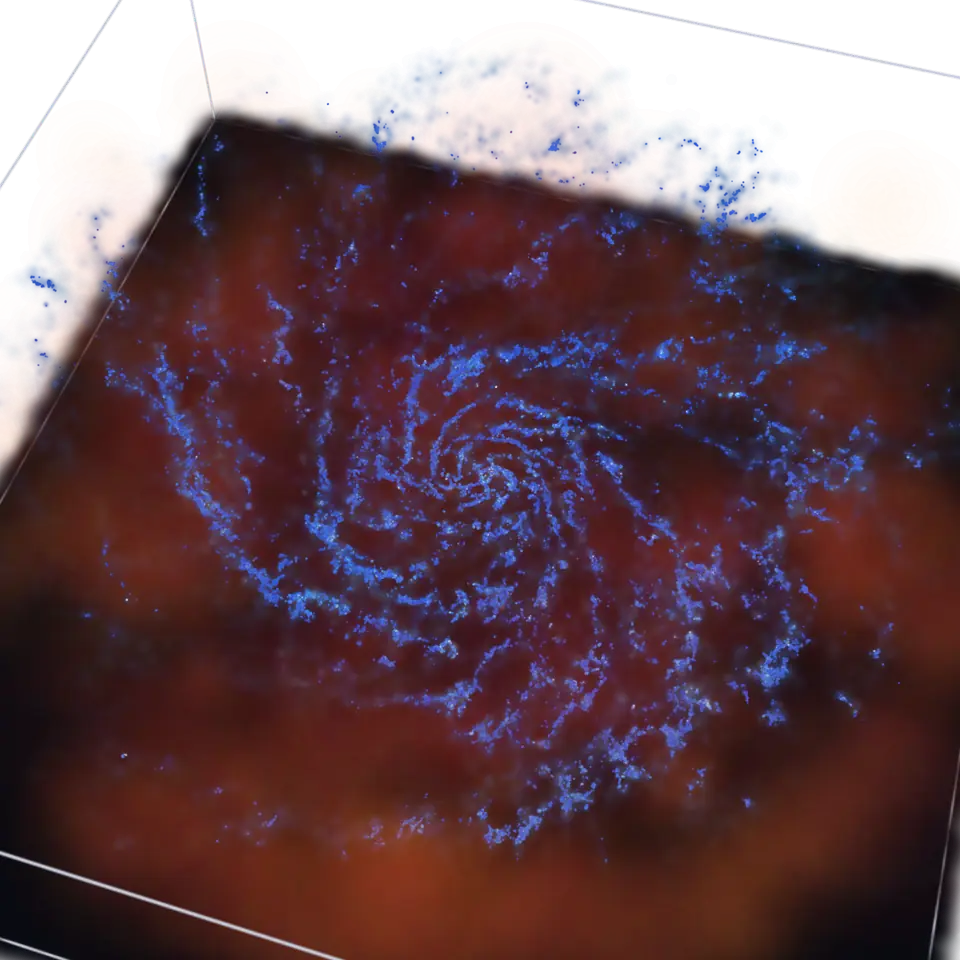
Galaxy simulations follow gas and stars as particles.
- Shelf
- Science
- Kind
- Built from a recipe
- Sound
- Yes
- Licenses
- CC BY 4.0
Its note
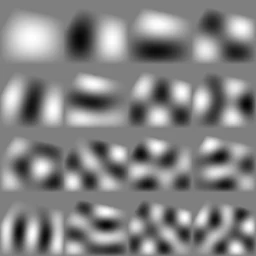
Splashery stretches a drumhead over this Splash's outline, twelve inches across, and finds the ways it can ring. Its lowest is 259.4 Hz, 15 cents flat of C4. The next fifteen are its overtones, and each one draws its own figure: sand gathers on the lines that stay still.
- 1259 Hz
- 2388 Hz
- 3432 Hz
- 4527 Hz
- 5536 Hz
- 6613 Hz
- 7651 Hz
- 8684 Hz
- 9698 Hz
- 10784 Hz
- 11788 Hz
- 12807 Hz
- 13846 Hz
- 14870 Hz
- 15911 Hz
- 16936 Hz
How to play
Pinch to zoom into the gas; tap to peel the hot gas. Through the telescope, tap for a new exposure.
Its controls
| Control | Kind | Range | Start |
|---|---|---|---|
| Peel away the hot gas | Tap | ||
| Only the cold gas | Switch | Off | |
| A new exposure | Switch | Off | |
| Galaxy | List | 3 choices | A Milky Way–mass galaxy today |
| View | List | 2 choices | The gas (the simulation) |
| Telescope filter | List | 3 choices | Color (blue, green and red) |
| Telescope's sharpness | List | 3 choices | A good night on the ground (1″) |
| Color by | List | 2 choices | Temperature |
| The box | Setting |
About it
Galaxy simulations follow gas and stars as particles. These are subsets of three FIRE-2 simulations: a galaxy of roughly the Milky Way's mass today, the same galaxy 10.4 billion years ago, and a dwarf galaxy. They are simulations, not telescope images. Each gas particle is a Gaussian about as wide as its smoothing kernel (the real kernel isn't Gaussian), colored by temperature or density; tap to keep only the cold gas.
Through a telescope (simulated) shows what an observer might record if the galaxy were 160 million light-years away: its star particles, bluer and brighter when young, blurred by the telescope's sharpness, with cold, dense gas dimming them like dust. Choose a filter; each tap starts a new exposure whose grainy photon noise smooths out as light builds up. The colors use a rough rule for how starlight fades with age, so it is a picture to explore, not a measurement.
Details
- Splats
- Opens at 200,000 at Mid Detail, 58,499 at Low, and up to 200,000 at Max
Sources and credits
| Work | By | License |
|---|---|---|
| FIRE-2 cosmological zoom-in simulation m12i, snapshot 600 (z = 0), gas | The FIRE project: Wetzel et al. (2023, 2025), Hopkins (2015), Hopkins et al. (2018); m12i from Wetzel et al. (2016). A subset: 300,000 of the 2.45 million gas particles in a 40 kpc box round the galaxy | CC BY 4.0 |
| FIRE-2 cosmological zoom-in simulation m12i, snapshot 172 (z = 2), gas and stars | The FIRE project: Wetzel et al. (2023, 2025), Hopkins (2015), Hopkins et al. (2018); m12i from Wetzel et al. (2016). A subset of the particles in a 24 kpc box round the galaxy | CC BY 4.0 |
| FIRE-2 cosmological zoom-in simulation m11h, snapshot 600 (z = 0), gas and stars | The FIRE project: Wetzel et al. (2023, 2025), Hopkins (2015), Hopkins et al. (2018); m11h from El-Badry et al. (2018). A subset of the particles in a 16 kpc box round the galaxy | CC BY 4.0 |