Earth and Maps · Built from a recipe
Stork Migration
E♭4 on the minor comb. Its drum rings at 299.3 Hz.
White storks fly thousands of kilometers each fall from Europe to Africa, and back in spring.
- Shelf
- Earth and Maps
- Kind
- Built from a recipe
- Sound
- Yes
- Licenses
- CC0, Public domain
Its note
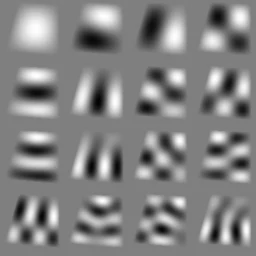
Splashery stretches a drumhead over this Splash's outline, twelve inches across, and finds the ways it can ring. Its lowest is 299.3 Hz, 67 cents flat of E♭4, the nearest tine on the comb. The next fifteen are its overtones, and each one draws its own figure: sand gathers on the lines that stay still.
- 1299 Hz
- 2463 Hz
- 3481 Hz
- 4601 Hz
- 5651 Hz
- 6677 Hz
- 7753 Hz
- 8781 Hz
- 9844 Hz
- 10874 Hz
- 11901 Hz
- 12929 Hz
- 13973 Hz
- 141036 Hz
- 151052 Hz
- 161072 Hz
How to play
Tap to play the storks' fall migration from Germany to Africa.
Its controls
| Control | Kind | Range | Start |
|---|---|---|---|
| Play the fall migration | Tap | ||
| Fly | Button |
About it
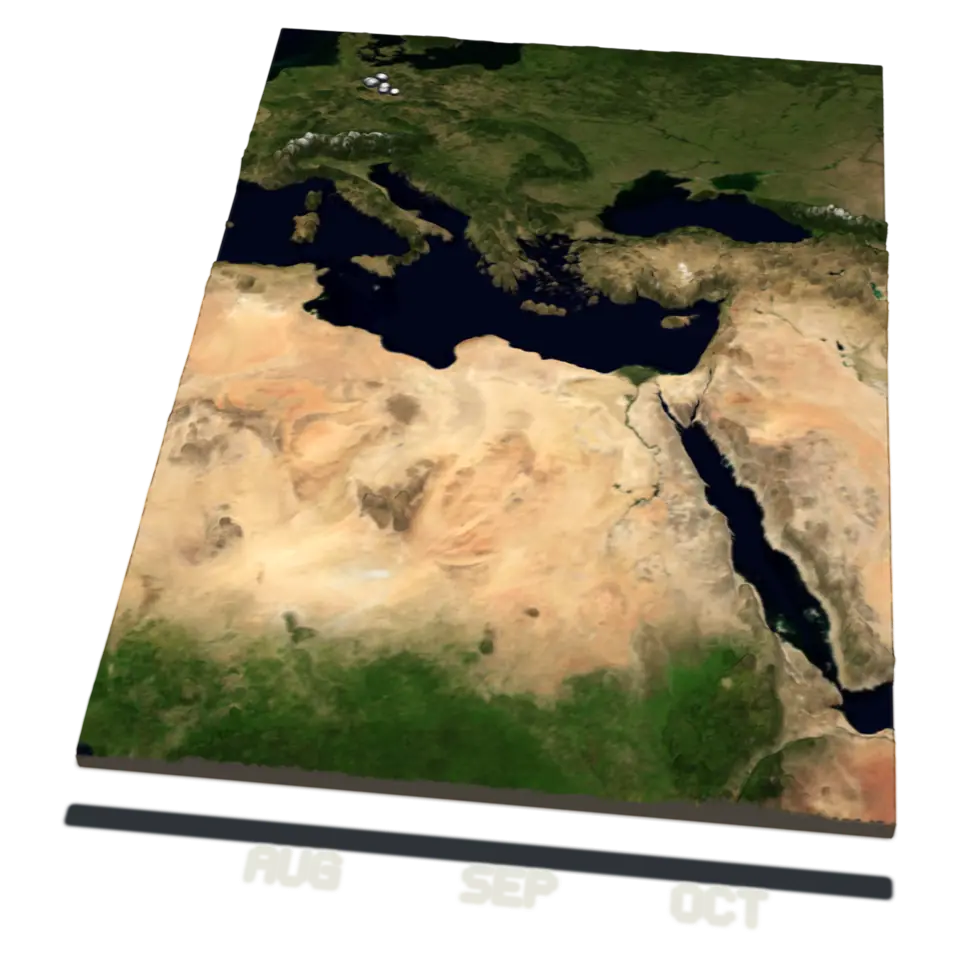
White storks fly thousands of kilometers each fall from Europe to Africa, and back in spring. They soar on rising warm air and avoid long sea crossings, so storks from eastern Germany go round the Mediterranean by the Bosporus, Turkey, Israel and the Nile valley.
These are 30 real storks, juveniles and adults, tracked by GPS in 2013 by S. Rotics and colleagues and published on Movebank under a CC0 license, one position every six hours. Tap it to play July to October in about 12 seconds: each stork leaves its nest when it really did and draws its own trail behind it. Then the season rewinds, and the storks fly their tracks back to their nests. The map is NASA's Blue Marble picture of the Earth's true colors, on heights from NOAA's ETOPO1 stretched up 45 times.
Details
- Splats
- Opens at 200,000 at Mid Detail, 127,844 at Low, and up to 830,000 at Max
Sources and credits
| Work | By | License |
|---|---|---|
| Data from: The challenges of the first migration (white storks, Rotics et al. 2016) | S. Rotics, M. Kaatz, Y. S. Resheff, S. F. Turjeman, D. Zurell, N. Sapir, U. Eggers, A. Flack, W. Fiedler, F. Jeltsch, M. Wikelski and R. Nathan (Movebank Data Repository) | CC0 1.0 |
| Blue Marble: Next Generation (true color), through NASA GIBS | NASA Earth Observatory | Public domain |
| ETOPO1 Global Relief Model | NOAA National Centers for Environmental Information | Public domain |