Science · Built from a recipe
Ripple Tank
C4 on the minor comb. Its drum rings at 282.5 Hz.
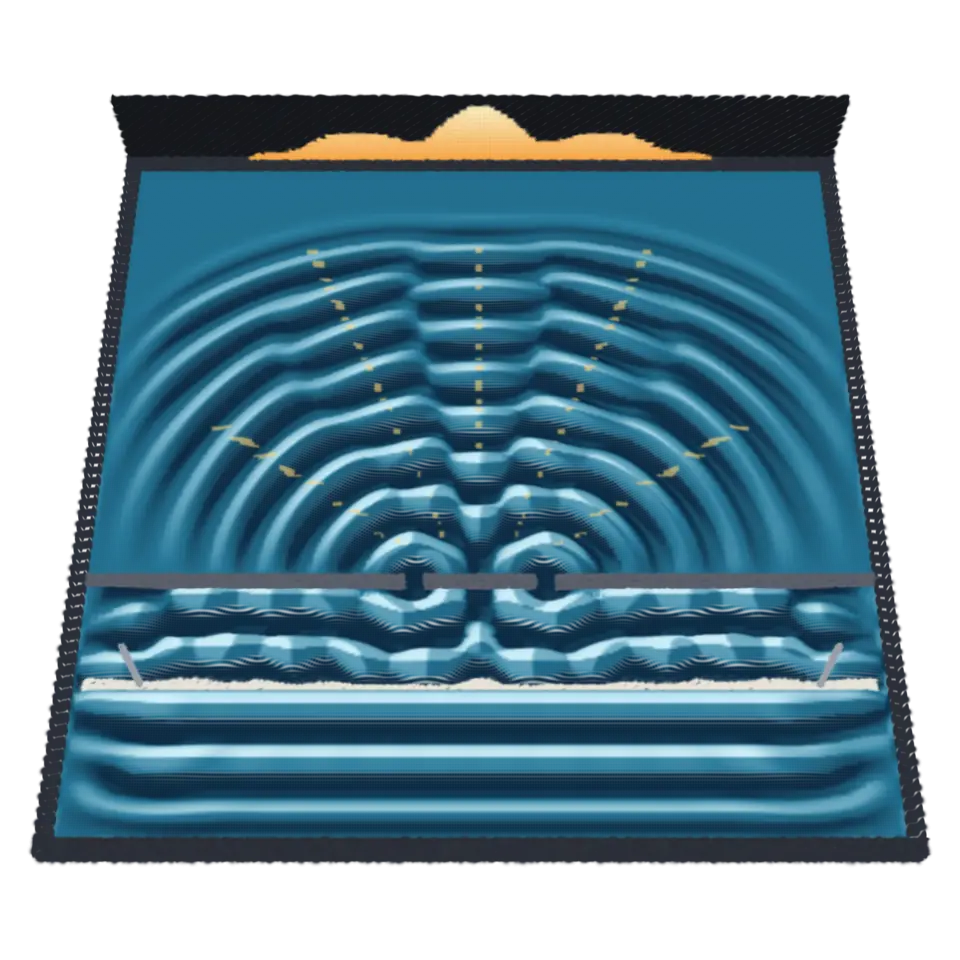
A ripple tank shows how waves spread, bend round edges and add up.
- Shelf
- Science
- Kind
- Built from a recipe
- Your own
- The numbers
- Sound
- Yes
- Licenses
- Own work (made in the page)
Its note
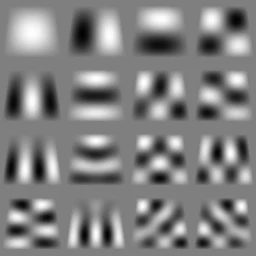
Splashery stretches a drumhead over this Splash's outline, twelve inches across, and finds the ways it can ring. Its lowest is 282.5 Hz, 133 cents sharp of C4, the nearest tine on the comb. The next fifteen are its overtones, and each one draws its own figure: sand gathers on the lines that stay still.
- 1283 Hz
- 2442 Hz
- 3450 Hz
- 4567 Hz
- 5619 Hz
- 6637 Hz
- 7720 Hz
- 8725 Hz
- 9800 Hz
- 10829 Hz
- 11853 Hz
- 12892 Hz
- 13900 Hz
- 14979 Hz
- 15999 Hz
- 161002 Hz
How to play
Tap the water to drop a pebble. Pick a setup and slide the frequency and speed in the Splash tab.
Its controls
| Control | Kind | Range | Start |
|---|---|---|---|
| Drop a pebble | Tap | ||
| Frequency (4 to 10 Hz) | Slider | 0 to 100% | 67% |
| Wave speed (15 to 30 cm/s) | Slider | 0 to 100% | 33% |
| Sources on | Switch | On | |
| Show where d·sin θ = m·λ puts the bright lines | Switch | On | |
| Drop a pebble | Button | ||
| Setup | List | 6 choices | Double slit |
| Slit width (cm) | Setting | ||
| Slit or dipper spacing (cm) | Setting |
About it
A ripple tank shows how waves spread, bend round edges and add up. This one solves the real two-dimensional wave equation on a grid of 216 × 216 cells (finite differences, with a time step small enough to stay stable), drawn as a fine surface of splats lifted by the water's height and lit so the crests catch the light. Sloping beaches at the edges soak the waves up, as in a real tank.
Through two slits, the waves add where their paths differ by whole wavelengths, so bright lines fan out at the angles d·sin θ = m·λ gives; the dotted lines mark them. Through one slit, the beam spreads wider as the slit gets narrower. The bars on the back wall show how strong the waves are along the far side. The numbers are in the Splash tab.
What it simplifies: real ripples on shallow water change speed a little with their wavelength; here every wavelength moves at the speed you set. The heights are exaggerated and the motion is four times slower than real.
Details
- Splats
- Opens at 200,000 at Mid Detail, 54,000 at Low, and up to 200,000 at Max
Is it right?
The ripple tank solves the two-dimensional wave equation on a grid and draws the water's height. Through two slits its bright fringes land where d·sin θ = m·λ says, and a single slit's beam spreads wider as the slit narrows, both measured from the simulation itself. The water is shown slowed down and with its heights exaggerated, and every wavelength travels at the one speed set.
Correct
The water follows the wave equation ∂²u/∂t² = c²∇²u, solved by finite differences.1
Each step updates every cell from its four neighbors with the standard second-order centered scheme (the five-point Laplacian); a damping term is added only in the beaches at the edges.
Correct
The time step is small enough for the scheme to stay stable.2
Δt is set so the Courant number c·Δt/Δx is 0.5 at the fastest speed the controls allow, so even the sum over both directions (2 × 0.5) stays at the limit of 1.
Correct
The edges absorb the waves, like the sloping beaches of a real ripple tank.3
A border 5 cm wide damps the water, gently at its inner edge and more toward the wall (as the square of the depth into it), so a ring crosses it and dies instead of bouncing back.
Close
Through two slits d apart, the bright fringes are at angles where d·sin θ = m·λ.4
The test runs a plane wave through two slits in a large tank and measures the time-averaged strength of the water along an arc 52 cm from the slits, then finds its peaks.
Close
A single slit's beam spreads wider as the slit narrows, with its first dark fringe at sin θ = λ / a.4
The test measures the beam's half width for slits 12, 8 and 5 cm wide, and the first dark fringe for the 8 cm slit.
Correct
The dotted lines mark where the two paths differ by a whole number of wavelengths.4
For each cell past the slits (or the two dippers) the splash works out the difference of its distances to the two and dots the cells where it is a multiple of λ; far away these lines run at the angles d·sin θ = m·λ gives.
- 1Wave equation, Wikipedia
- 2Courant–Friedrichs–Lewy condition, Wikipedia
- 3Ripple tank, Wikipedia
- 4Double-slit experiment, Wikipedia
- Simplified
- Real ripples on shallow water are dispersive (their speed changes a little with the wavelength, and surface tension matters for short ones); here every wavelength moves at the speed set by the slider.
- Simplified
- The motion is shown four times slower than real, and the heights are exaggerated so the crests can be seen.
- Simplified
- The light and shade are worked out from the water's slope and curvature for the picture; they are not a ray-traced image of a lamp through water.
- Simplified
- The dippers are idealized: each holds a small disc of water to a sine wave.
Sources and credits
Made in Splashery. Its code is MIT.