Space · Built from a recipe
Saturn V
E6 on the major comb. Its drum rings at 1344.6 Hz.
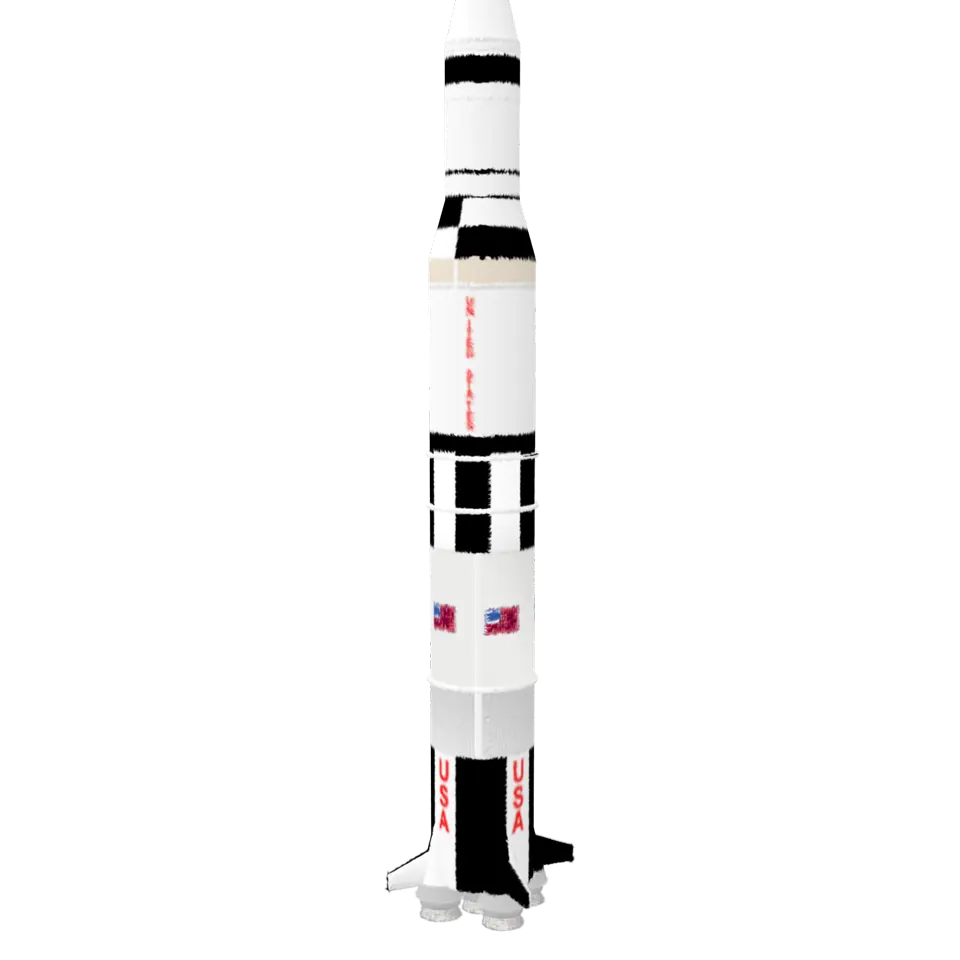
The Saturn V, the rocket that sent astronauts to the Moon from 1968 to 1972, as splats from NASA's 3D model.
- Shelf
- Space
- Kind
- Built from a recipe
- Made from
- NASA's model of the Saturn V. A tap fires its stages in the order of a real flight, much faster: the first stage, the ring below the second, the escape tower, the second stage, then the spacecraft leaves the third stage.
- Sound
- Yes
- Licenses
- US government work
Its note
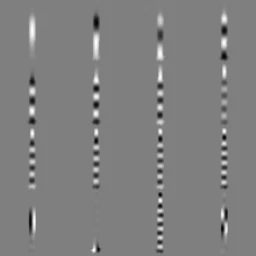
Splashery stretches a drumhead over this Splash's outline, twelve inches across, and finds the ways it can ring. Its lowest is 1344.6 Hz, 34 cents sharp of E6. The next fifteen are its overtones, and each one draws its own figure: sand gathers on the lines that stay still.
- 11345 Hz
- 21430 Hz
- 31491 Hz
- 41591 Hz
- 51708 Hz
- 61846 Hz
- 71979 Hz
- 82068 Hz
- 92166 Hz
- 102293 Hz
- 112413 Hz
- 122539 Hz
- 132620 Hz
- 142630 Hz
- 152675 Hz
- 162691 Hz
How to play
Tap to fire its stages in the order of a real flight.
Its controls
| Control | Kind | Range | Start |
|---|---|---|---|
| Fire the stages in order | Tap | ||
| Stage it | Button |
About it
The Saturn V, the rocket that sent astronauts to the Moon from 1968 to 1972, as splats from NASA's 3D model. Its three stages were the S-IC with five F-1 engines, the S-II with five J-2s and the S-IVB with one J-2; the Apollo spacecraft rode on top under its escape tower.
Tap to stage it in the order of Apollo 11's flight, much faster than real: the first stage falls away at 2 minutes 40 seconds, then the ring below the second stage and the escape tower; the second stage at 9 minutes 8 seconds; the spacecraft leaves the third stage about three and a half hours after launch. The model paints a band of the first stage navy; the real one was white, so it is drawn white.
Is it right?
NASA's 3D model of the Saturn V, cut into its stages where the model's width steps, staging in the order of Apollo 11's flight, much faster than real.
Correct
The pieces separate in the order of a real flight: the S-IC, the interstage ring, the launch escape tower, the S-II, then the spacecraft leaves the S-IVB.1
The drive moves each piece at its time on a 12-second clock; the test checks the order.
Close
The S-IC is the bottom 38% of the rocket's height (42 m of 110.6 m).1
The pieces are cut at shares of the model's height where its width steps, checked against the stages' lengths.
- 1Saturn V, Wikipedia
- Simplified
- Staging that took hours is shown in 12 seconds.
- Simplified
- The flames are glowing cones, not a simulation of the exhaust.
- Simplified
- The model paints a band of the first stage navy blue; the real stage was white there, so it is drawn white.
- Simplified
- The panels round the lunar module and the lunar module itself are not shown separately.
Sources and credits
| Work | By | License |
|---|---|---|
| Saturn V (NASA 3D Resources) | NASA (Michael D. Carbajal) | NASA 3D Resources, used under NASA's media guidelines |